Concrete

Project 2.20: Efficiency of Fiber Reinforcement in Ultra-high Performance Concrete

Efficiency of Fiber Reinforcement in Ultra-high Performance Concrete Project 2.20 Project Summary The proposed research aims at investigating the efficiency of fiber reinforcement in ultra-high performance concrete (UHPC) mixtures. This proposed research is a necessary step for the successful completion of the development of non-proprietary UHPC mixtures. Since fiber reinforcement is the most expensive part […]

Read more
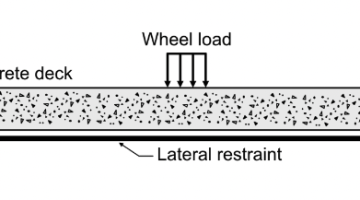
3.18 cover image of a diagram showing test method of concrete deck

Project 3.18: Steel-Free Concrete Bridge Decks

Steel-Free Concrete Bridge Decks Project 3.18: Project Summary In order to realize a potentially transformational improvement in concrete bridge deck durability, the proposed research program intends to validate a deck design by which little to no conventional reinforcement is required. The design relies on the development of so-called arching action to maintain compressive stresses in […]

Read more

2.18 cover image

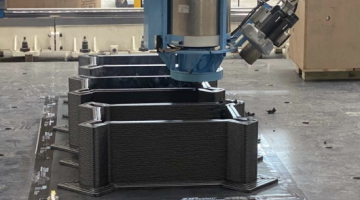
Project 2.18: Recycling Large-Scale 3 D-Printed Polymer Composite Precast Concrete Forms

Recycling Large-Scale 3 D-Printed Polymer Composite Precast Concrete Forms Project 2.18 Project Summary Large-scale thermoplastic composite extrusion-based 3D printing has been used in research labs and is moving into industry. One significant use of large-scale 3D printing has been to make forms for manufacturing precast concrete parts. Once the forms have been used for casting […]

Read more

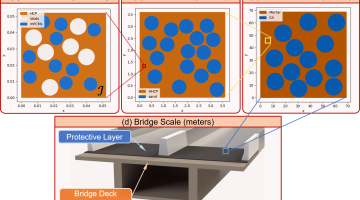
Project 2.16 Cover Image, three graphs and a model of a bridge part

Project 2.16: Enhancing the Durability of Bridge Decks by Incorporating Microencapsulated Phase Change Materials (PCMs) in Concrete

Enhancing the Durability of Bridge Decks by Incorporating Microencapsulated Phase Change Materials (PCMs) in Concrete Project 2.16 Project Summary In Rhode Island and other New England states, combined effects of freeze-thaw-induced damage and chloride ingress (from deicing salts) make it very challenging to maintain the quality of concrete on bridges and road surfaces. This project […]

Read more

2.14 cover image

Project 2.14: Implementation of UHPC Technology into the New England Construction Industry

Implementation of UHPC Technology into the New England Construction Industry Project 2.14 Project Summary The proposed research aims at the development and implementation of cost effective non-proprietary high and ultrahigh performance concrete (UHPC) mix designs. Research emphasis is being placed on testing and analysis of durability properties of promising UHPC mixtures, as well as testing […]

Read more

Large metal helical pile sitting on a pallet

Project C17:2020: Durability of Modified Helical Piles Under Lateral and Torsional Loads: Embracing Efficient Foundation Alternatives to Support Lightweight Transportation Structures

Durability of Modified Helical Piles Under Lateral and Torsional Loads: Embracing Efficient Foundation Alternatives to Support Lightweight Transportation Structures Project C17.2020 Project Summary Modified helical (i.e. screw) piles are lightweight deep foundation elements that are screwed into the ground and efficiently generate geotechnical compressive and uplift resistance by mobilizing the shear strength of soil adjacent […]

Read more

2.13 cover image

Project 2.13: Performance Structural Concrete Optimized for Cost, Durability and Manufacturability

Performance Structural Concrete Optimized for Cost, Durability and Manufacturability Project 2.13 Project Summary The primary goal is to develop prescriptive concrete mix designs that meet modern high- performance durability requirements while being practical to manufacture with New England-sourced materials and suppliers. These new Performance Concrete or High Performance Concrete (HPC) mix designs use graded aggregates, […]

Read more

Line graph titled 'Design and Final Gamma Distributions'

Project C09.2019: A New Method of Determining Payment for In-Place Concrete with Double- Bounded Compressive Strength Pay Factors

A New Method of Determining Payment for In-Place Concrete with Double-Bounded Compressive Strength Pay Factors Project C9.2019 Project Summary The Vermont Agency of Transportation (VTrans) currently uses a lower acceptance limit on 28-day concrete compressive strength (CCS) of 4,000 psi for acceptance of in-place concrete in its construction projects. Over time, to mitigate risk, the […]

Read more

2.02 cover image

Project 2.02: Concrete Systems for a 100-Year Design Life

Concrete Systems for a 100-Year Design Life Project 2.2 Project Summary The overall objective is to develop a suite of highly durable concrete systems suitable for a range of transportation infrastructure applications, given the range of constituent availability (e.g. appropriate aggregates, supplementary cementitious materials), conventions for structural details, and typical New England exposure conditions ranging […]

Read more