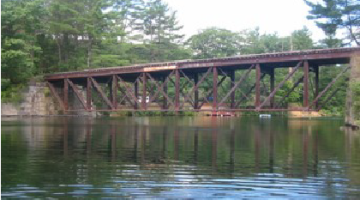
Thrust Area 1

1.13 cover image

Project 1.13: Structural Integrity, Safety, and Durability of Critical Members and Connections of Old Railroad Bridges under Dynamic Service Loads and Conditions

Structural Integrity, Safety, and Durability of Critical Members and Connections of Old Railroad Bridges under Dynamic Service Loads and Conditions Project 1.13 Project Summary Most of the New England railway bridges were designed and built more than a century ago with outdated design codes and materials. The objective of this research project is to investigate […]

Read more
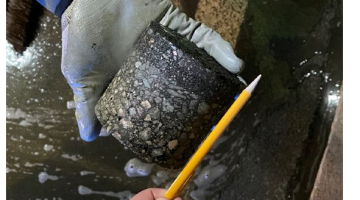
1.17 cover image

Project 1.17: Determining Layer Thickness and Understanding Moisture Related Damage of State-Owned Roads Using GPR and Capturing Such in a GIS-Based Inventory

Determining Layer Thickness and Understanding Moisture Related Damage of State-Owned Roads Using GPR and Capturing Such in a GIS-Based Inventory Project 1.17 Project Summary The Rhode Island Department of Transportation (RIDOT) has a significant inventory of state-owned roads of which layer thickness and moisture related damage is uncertain. Discrete methods of assessment like coring and […]

Read more

Large metal helical pile sitting on a pallet

Project C17:2020: Durability of Modified Helical Piles Under Lateral and Torsional Loads: Embracing Efficient Foundation Alternatives to Support Lightweight Transportation Structures

Durability of Modified Helical Piles Under Lateral and Torsional Loads: Embracing Efficient Foundation Alternatives to Support Lightweight Transportation Structures Project C17.2020 Project Summary Modified helical (i.e. screw) piles are lightweight deep foundation elements that are screwed into the ground and efficiently generate geotechnical compressive and uplift resistance by mobilizing the shear strength of soil adjacent […]

Read more

1.12 Cover Image

Project 1.12: Improved UAV-Based Structural Inspection Techniques and Technologies for Northeast Bridges

Improved UAV-Based Structural Inspection Techniques and Technologies for Northeast Bridges Project 1.12 Project Summary Unmanned aerial vehicles (UAVs) or “drones” are revolutionizing some basic reconnaissance, including structural inspections. This project seeks to enhance and expand the range of applications for unmanned aerial vehicles (UAVs) to aid inspection of transportation structures. This project is primarily aimed […]

Read more

c19.2020 cover image showing satellite image of buildings and parking lots next to river that is shown with thermal imaging

Project C19.2020: Damage Modeling, Monitoring, and Assessment of Bridge Scour and Water Borne Debris Effects for Enhanced Structural Life

Damage Modeling, Monitoring, and Assessment of Bridge Scour and Water Borne Debris Effect for Enhanced Structural Life Project C19.2020 Project Summary The objective of this project is to evaluate bridge failure risk due to bridge scour and waterborne debris impacts to enable predictive management for enhanced structural life. The proposed multi-disciplinary project will establish a […]

Read more

c20.2020 cover image

Project C20.2020: Advanced Sensing Technologies for Practical UAV-Based Condition Assessment

Advanced Sensing Technologies for Practical UAV-Based Condition Assessment Project C20.2020 Project Summary The problem we are trying to investigate is the synergistic application of unmanned aerial vehicles (UAVs) with active acoustic sensing (AAS) and synthetic aperture radar (SAR) for the underside inspection of bridge decks. The problem is important because that employing such UAV-AAS-SAR system […]

Read more

Line graph titled 'Design and Final Gamma Distributions'

Project C09.2019: A New Method of Determining Payment for In-Place Concrete with Double- Bounded Compressive Strength Pay Factors

A New Method of Determining Payment for In-Place Concrete with Double-Bounded Compressive Strength Pay Factors Project C9.2019 Project Summary The Vermont Agency of Transportation (VTrans) currently uses a lower acceptance limit on 28-day concrete compressive strength (CCS) of 4,000 psi for acceptance of in-place concrete in its construction projects. Over time, to mitigate risk, the […]

Read more

C11.2019 cover image, UMass workers inspecting bridge girders

Project C11-2019: Development of a system-level distributed sensing technique for long- term monitoring of concrete and composite bridges

Development of a System-level Distributed Sensing Technique for Long-Term Monitoring of Concrete and Composite Bridges Project C11.2019 Project Summary The problem we are trying to solve is the long-term monitoring problem of bridges (e.g., concrete and composite bridges), using multiple modes of sensing technology including distributed fiber optic, video motion, conventional strain gauge, and electromagnetic […]

Read more

c5.2018 cover image

Project C05.2018: Leveraging High-Resolution LiDAR and Stream Geomorphic Assessment Datasetsto Expand Regional Hydraulic Geometry Curves for Vermont: A Blueprint for NewEngland States

Leveraging High-Resolution LiDAR and Stream Geomorphic Assessment Datasets to Expand Regional Hydraulic Geometry Curves for Vermont: A Blueprint for New England States Project C5.2018 Project Summary Regional hydraulic geometry curves (RHGCs) for Vermont have been updated through development of additional observations and use of newly-available high-resolution lidar and stream geomorphic assessment data to improve the […]

Read more

C3.2018 cover image sensors connected to corrosion bath

Project C03.2018: Condition Assessment of Corroded Prestressed Concrete Bridge Girders

Condition Assessment of Corroded Prestressed Concrete Bridge Girders Project C3.2018 Project Summary The problem we are trying to solve is the condition assessment of corroded prestressed concrete (PC) bridge girders in New England. The problem is important because that PC bridge girders are a critical component of highway bridges. Concrete spalling and prestressing strand corrosion […]

Read more